Showing posts with label AARP. Show all posts

Saturday, January 18, 2014

Seniors Beware: Medicare is in Danger

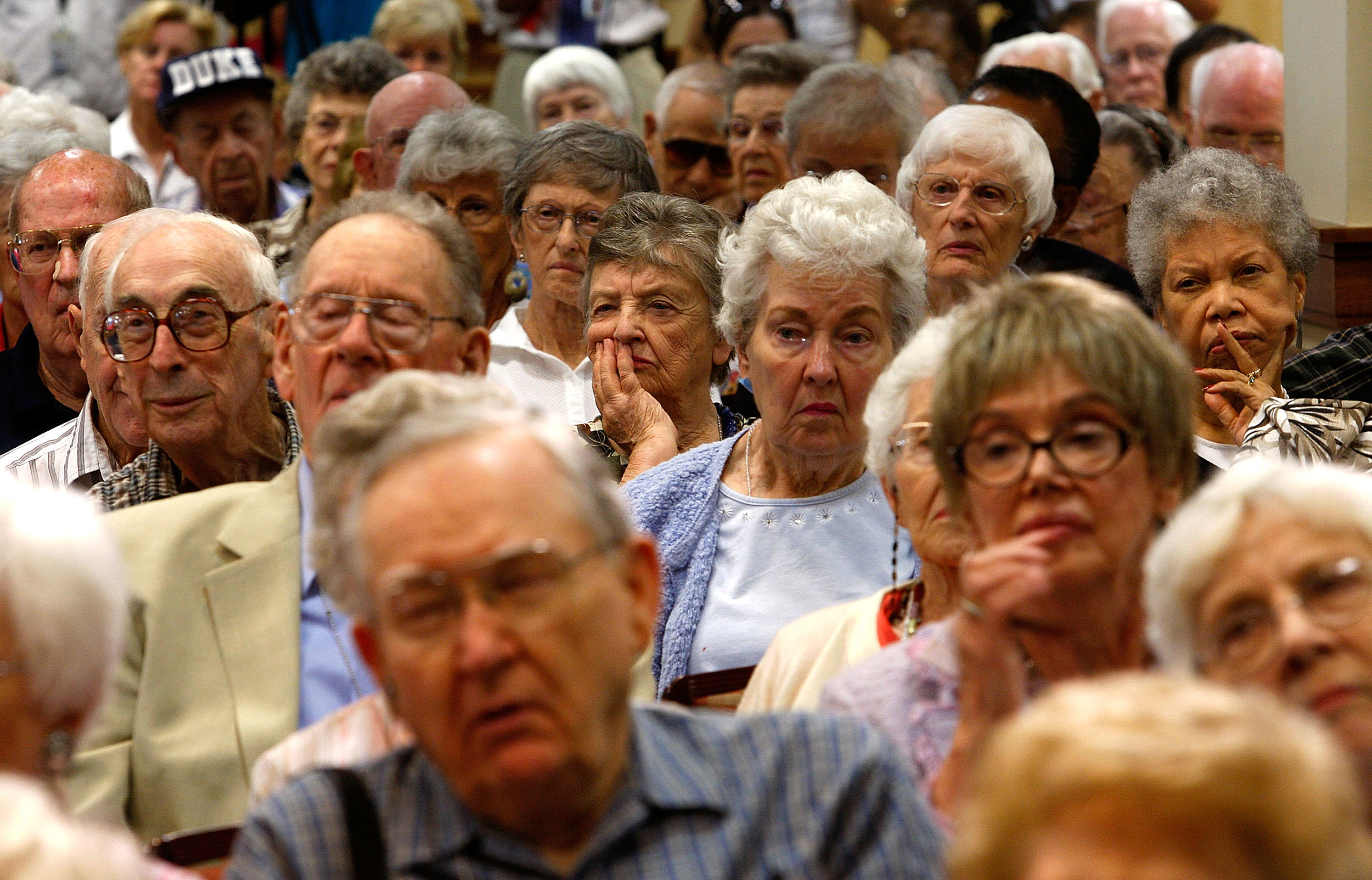
A recent article in the AARP Bulletin  asks the question, "Is Your Medicare Safe?"  In her article, Marsha Mercer, points to a section of the law which reads, "nothing in this act shall result in a reduction of guaranteed benefits."  This obviously was put in the act to mollify seniors with their great fear that Medicare may be gutted and taken away from them as a benefit. The mere fact that $716 billion are going to be cut from Medicare over 10 years does not seem to bother Ms. Mercer.

I agree that $716 billion  over 10 years will probably not place a significant dent in the benefits supplied through Medicare, as there is room for many readjustments in efficiency and provider reimbursement to probably satisfy this debt, but Medicare is not safe, and it would be best that future seniors understand how government functions.

When Medicare was passed by the Congress in 1965 there was a energetic debate about this new law. Various representatives claimed that "the government will control American Medicine, and tell people when they can go into the hospital and when they can't. It will tell physicians how much they can be paid for their services." The proponents of this law basically "solved" these objections by placing a first paragraph at the beginning of the new Medicare law that can be found by looking it up on various websites. This first paragraph was so important that  this law would not have passed without it, and the title of that first paragraph exposes both the methods and the direction of government control.

The title of the first paragraph was  "POHIBITION AGAINST ANY FEDERAL INTERFERENCE."  This particular paragraph was placed there to assuage the fears of conservatives that the government would control medical care in our country, but as we all know, the paragraph had nothing to do with future laws that were passed, or promises that were made about federal interference. The federal government currently controls at least 65 to 70% of medical care, and it does control how much physicians are paid, and who can go into a hospital and when they go home. The details of what else  it controls are too numerous to enumerate in this brief article,  but let's just say it controls just about everything.

Having a statement in the Medicare law of "nothing in this act shall result in a reduction of guaranteed benefits" is no different than saying, "Prohibition against Any Federal Interference,"  And this is been said before I are government specifically in 1965 with the passage of the Medicare law. In case you haven't read that paragraph I'm going to include it in this essay: "

PROHIBITION AGAINST ANY FEDERAL INTERFERENCE

Sec1801[42 U.S.C. 1395]  Nothing in this title shall be construed to authorize any Federal officer
or employee to exercise any supervision or control over the practice of medicine or the manner in which medical services are provided, or over the selection, tenure, or compensation of any officer or employee of any institution, agency, or person providing health services; or to exercise any supervision or control over the administration or operation of any such institution, agency, or person."

I hope you noticed that the paragraph begins with the statement "nothing in this title" and that is just what is included in the Affordable Care Act.

The basic idea is that governments say what they like and then do what they have to further down the line. They can always come up with excuses such as, "it's too expensive or it's causing too many unforeseen consequences, yada yada yada." The point is there is always an excuse and many times the people who passed the law are not present in government when they come up with a reason to change it.

Concluding that a brief statement in the Medicare law will protect us from further consequences is not only naïve but dangerous. It's giving elderly a false sense of security which is definitely not present the way the demographics are moving in this country.

The elderly are increasing and the number of workers to support our "benefits" is gradually decreasing. The promises that were made are not necessarily sustainable.

In a different sense it's not really fair for the elderly to base their retirement on the backs of younger people. Younger people have a right to the same opportunities that their parents and grandparents had when they were young. I worry that the tax situation in this country will only get worse for young adults if we continue down this same road to entitlements and Medicare is a big one.

There are serious questions anyway about the AARP's support of the affordable care act. It is my understanding that various executives in the AARP received government jobs after the passage of this law. Did this have anything to do with their support of the ACA? Those who believe that "nothing in this act show result in a reduction in guaranteed benefits" probably believe that there was no relationship between the nice cushy government jobs received by various AARP executives and  their support of the ACA.

I think changes are coming, and AARP would be wise to let seniors understand it. 

Sunday, March 4, 2012

AARP MedicareRx, Prescription Solutions Ripping Us Off

I  signed up for the AARP  prescription drug plan offered by United  Healthcare approximately one year ago.  I thought, as a member of AARP,  that I would be treated fairly and that the health plan would be reasonable and honest with its dealings with me.  I believe I have discovered  otherwise.


I must admit I was sent a pamphlet that contained all of the “annual notice of changes” but I should have reviewed it very carefully. It turns out that they have raised my fees in 3 different areas. Two of these areas are acceptable, but the 3rd I  view as completely unjustified, exorbitant, and an indication of an uncertain future with my dealing with this company.

They raised my usual monthly charge for a standard prescription from $7-$8. They also raised by monthly premium from $33.40 to $38.90. Although this seems a bit steep, it doesn't particularly seem unreasonable.

The problem that I have is with the 3rd item. They have raised the cost of a three-month prescription of metoprolol succinate 25 mg ER from $7 to over $66. That is a raise of over 900%. The explanation I get from the company is that it is an  extended release tablet, and therefore it is a tier 3 drug. Other companies, namely Blue Cross Blue Shield, make it a tier 1 drug. Frankly, I'm certain other companies make it a tier 1 drug also. I believe that last year it was a tier 1 drug with this United Healthcare Plan.

I can see no reason for raising this drug to a tier 3 drug unless they wish to make an unfair profit. This drug is a generic drug and has been around for quite some time. It is not as if it's a new drug or whether it was just changed to an extended release drug. I have gotten no satisfaction from the company over this issue.

I am writing this so that other members of this drug  plan can become aware of this problem and submit protests to the company just as I have. I find this action by United Healthcare Insurance Company to be arbitrary and capricious. It is simply another way of abusing the public by gaining exorbitant profit.

If for some reason I get an explanation that is reasonable I will retract this article. But if I don't I hope others will read this and submit their own complaints.  My basic point  is beware of this drug plan. Once they get away with this sort of unreasonable price gouging it will  become evident in other ways.

Tuesday, February 15, 2011

Retirement, What Does it Mean?

I retired on January 1, 2011. Oh my God! Retired? "What are you going to do?" The most common question that points to  only part of the fear of this life changing event. I had worked since age 13, because my vigilant mother "kept me off the streets of Chicago" when I was growing up. Probably a prudent idea. I was a creative energetic young man and probably would have thought of many pranks to land me in the dog house.  Pranks like joining the Crandon gang-- we lived on Oglesby--and getting into rock fights with others in the neighborhood.  Even better, throwing a mud ball into the window of a neighbor during a quiet summer night. But I'm all "growed up" now, and have found it in me to retire.
Two specific thoughts encouraged me.  Two good reasons that compelled me to draw that inevitable line in the sand, and cross over. Retirement generates a lot of fears as it approaches, but my reasons pushed me into it. They are good reasons. When I was younger, I used to joke that I will retire after my first heart attack. Fortunately, that didn't happen.

Carrying on with that theme, however, my first reason was that IT DOESN'T GO ON FOREVER. I have seen too many of my close friends "leave" during my 68 years on this earth. Paul died of pancreatic cancer at about 42, and Wilson died in Viet Nam shortly after we graduated from college. Along the road ( I was a physician) I saw many folks who met their maker too early. I think my previous profession planted the idea of eventual demise firmly in my thoughtful psyche. It's going to happen to all of us and, even if we don't believe it, the end will come. I wanted some time to enjoy life while I still had the blessing of reasonable health. I also observed that I began to resemble the patients I was operating on as I vaulted into my 60s. I found that this observation was--along with the increased Motrin I was taking-- a helpful warning that I was getting older and the time for leaving had arrived.

My second reason for retiring was that I had practiced medicine long enough. That might sound strange because most elderly workers say they "like their job," and I did too. It's just that I wanted to give myself the gift of doing something else. I have always had multiple interests, but while working, I didn't have the time to develop any of them. I viewed this idea of the "gift" as a form of self-respect. It was these two sound ideas that forced me to take the big leap.

Will I have enough money put away to retire? (Most of us believe we will never have enough.) What will I do? How much will I miss all the people at work? Am I really getting that old? Don't you fall apart as soon as you stop working? Keep active, and use your brain. How's your memory?  As I invade my wife's space at home, will we have to adjust to each other? There are just too many pertinent questions to answer, and they kept me so busy, I didn't have time to worry about retirement. My two reasons carried me forward.

I understand that there are 78 million Baby Boomers-- those born between Jan. 1,1946 and December 31, 1964--and they are reaching the age of 65 at the rate of 10,000 every day for the next 19 years. That's a lot of old people. and many of the statistics don't look promising.

According to the Congressional Budget Office, it will pay out more in Social Security benefits in 2010 than it receives. The Illinois Teachers Retirement System is 61% underfunded at this time. Finally, by 2025, there will be two workers for each retiree; in 1950 there were 16 workers for each retiree. Financially, the system doesn't look too healthy. Keeping all those retirees comfortable will be an augean task.

Under the best of circumstances, retirement can be looked at as a "rebirth": new challenges, new possibilities, and if one is fortunate in health, a few years to do and see things that were previously beyond the reach of time and work obligations.

As a physician, I was  fortunate to have a career that gave me the privilege and the opportunity to help people in need. I am hoping that I can find other activities and continue to contribute in different ways.

As I work my way along this new road, using my time well is one of my biggest challenges. Time becomes more precious as I grow older, and the benefit of retirement gives me the opportunity to choose how I spend it and inevitably to shape my future.